CBSE • Geometry & Mensuration

Heron's Formula & Math Notation

In this lesson, we explore Heron's Formula for calculating triangle areas when all three side lengths $a$, $b$, and $c$ are known.

💡 Teacher Guide: Teachers can write inline formulas using single dollar signs like $a^2 + b^2 = c^2$ or block formulas using double dollar signs $$ \dots $$.

Learning Objectives

  • Understand Heron's formula for finding the area of any triangle
  • Calculate semi-perimeter s = (a + b + c) / 2 accurately
  • Master writing LaTeX / KaTeX math formulas in Markdown

Lesson Explanation

Lesson Explanation

1. Semi-Perimeter Formula

First, calculate the semi-perimeter $s$, which is half of the total perimeter:

$$ s = \frac{a + b + c}{2} $$

2. Heron's Area Formula

Once $s$ is known, the area of triangle $ABC$ with sides $a$, $b$, and $c$ is given by:

$$ \text{Area} = \sqrt{s(s - a)(s - b)(s - c)} $$


📝 Teacher KaTeX Cheat Sheet & Examples

Here are examples of how teachers can write complex mathematical formulas in Markdown:

Math Topic How Teacher Writes in Markdown Rendered Math Output
Fractions $$ \frac{a + b}{c} $$ $$ \frac{a + b}{c} $$
Square Roots $$ \sqrt{b^2 - 4ac} $$ $$ \sqrt{b^2 - 4ac} $$
Quadratic Formula $$ x = \frac{-b \pm \sqrt{b^2 - 4ac}}{2a} $$ $$ x = \frac{-b \pm \sqrt{b^2 - 4ac}}{2a} $$
Exponents & Subscripts $x_1^2 + x_2^2 = y^n$ $x_1^2 + x_2^2 = y^n$
Trigonometry $$ \sin^2(\theta) + \cos^2(\theta) = 1 $$ $$ \sin^2(\theta) + \cos^2(\theta) = 1 $$
Summation & Limits $$ \sum_{i=1}^{n} i = \frac{n(n+1)}{2} $$ $$ \sum_{i=1}^{n} i = \frac{n(n+1)}{2} $$
💡 Key Takeaway

Take one step at a time, check your working carefully, and keep both sides balanced!

Worked Examples

Example 1

Find the area of a triangle with side lengths $a = 5\text{ cm}$, $b = 6\text{ cm}$, and $c = 7\text{ cm}$.
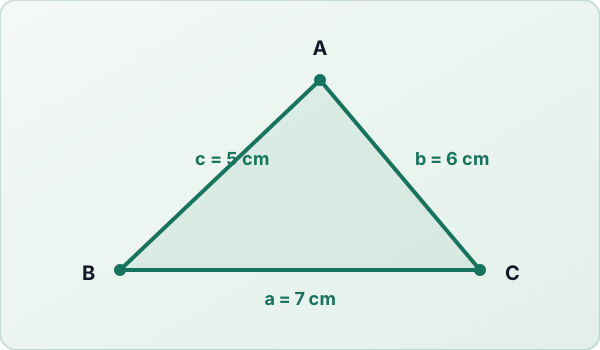
Question Diagram for Example 1
  1. Step 1

    Calculate semi-perimeter: $s = \frac{a + b + c}{2} = \frac{5 + 6 + 7}{2} = \frac{18}{2} = 9\text{ cm}$

  2. Step 2

    Find values for $(s - a)$, $(s - b)$, and $(s - c)$: $(9 - 5) = 4\text{ cm}$, $(9 - 6) = 3\text{ cm}$, $(9 - 7) = 2\text{ cm}$

  3. Step 3

    Substitute into Heron's formula: $\text{Area} = \sqrt{s(s - a)(s - b)(s - c)} = \sqrt{9 \times 4 \times 3 \times 2}$

  4. Step 4

    Simplify square root: $\text{Area} = \sqrt{216} = 6\sqrt{6}\text{ cm}^2 \approx 14.7\text{ cm}^2$

📸 View Worked / Handwritten Solution Image
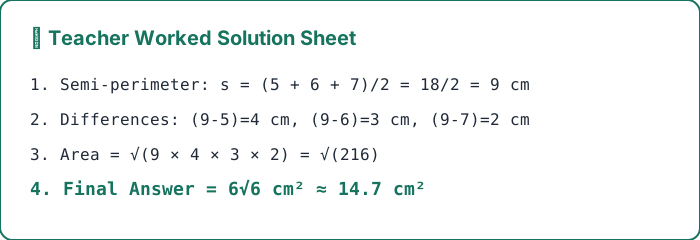
Solved Solution Image for Example 1

Example 2

Find the area of an isosceles triangle with equal sides of $10\text{ cm}$ and base of $12\text{ cm}$.

  1. Step 1

    Side lengths are $a = 10\text{ cm}$, $b = 10\text{ cm}$, $c = 12\text{ cm}$

  2. Step 2

    Calculate semi-perimeter: $s = \frac{10 + 10 + 12}{2} = 16\text{ cm}$

  3. Step 3

    Substitute into formula: $\text{Area} = \sqrt{16(16-10)(16-10)(16-12)} = \sqrt{16 \times 6 \times 6 \times 4}$

  4. Step 4

    Final Answer: $\text{Area} = 4 \times 6 \times 2 = 48\text{ cm}^2$

Visual Method

Balance Every Step

Mathematics becomes much clearer when you can see the structure behind equations.

Watch Video Explanation

Practice Questions

Try solving each question on paper first. Tap below to check a helpful hint or solution!

Question 1

Calculate the area of a triangle with sides $13\text{ cm}$, $14\text{ cm}$, and $15\text{ cm}$.

Show Hint / Solution 💡
Diagram for Question 1

First calculate $s = \frac{13 + 14 + 15}{2} = 21\text{ cm}$. Then substitute into $\text{Area} = \sqrt{s(s-a)(s-b)(s-c)}$.

📸 Solved Exercise Image:

Solved Solution for Question 1
Question 2

The sides of a triangle are in the ratio $3 : 5 : 7$ and its perimeter is $300\text{ m}$. Find its area.

Show Hint / Solution 💡

Let sides be $3x$, $5x$, $7x$. Solve $3x + 5x + 7x = 300 \implies x = 20\text{ m}$.

Lesson Summary

What to Remember

Calculate semi-perimeter first, then apply Heron's square root formula: Area = \sqrt{s(s-a)(s-b)(s-c)}.

Download Lesson Notes